
Summary
The White Paper is a system-wide reform document reviewing the 1998 White Paper on Local Government. Initiated by Cabinet in 2022 and publicly launched in May 2025, it draws on 266 public submissions, stakeholder engagements, and research papers. It contains approximately 65 policy recommendations across 10 substantive chapters, structured around five pillars: a unified local government system; clean and capable governance; differentiated powers and functions (with a pathway to a single-tier future); partnership-based relational governance; and financial and service delivery reform.
The White Paper is candid about the scale of failure: only 41 of 257 municipalities achieved clean audits in a recent snapshot; consumer debt to municipalities exceeded R400 billion by 2024/25; and Eskom tariffs to municipalities have risen by 910% in nominal terms since 2008 (quadrupling in real terms), severely eroding household affordability and municipal cross-subsidisation capacity.
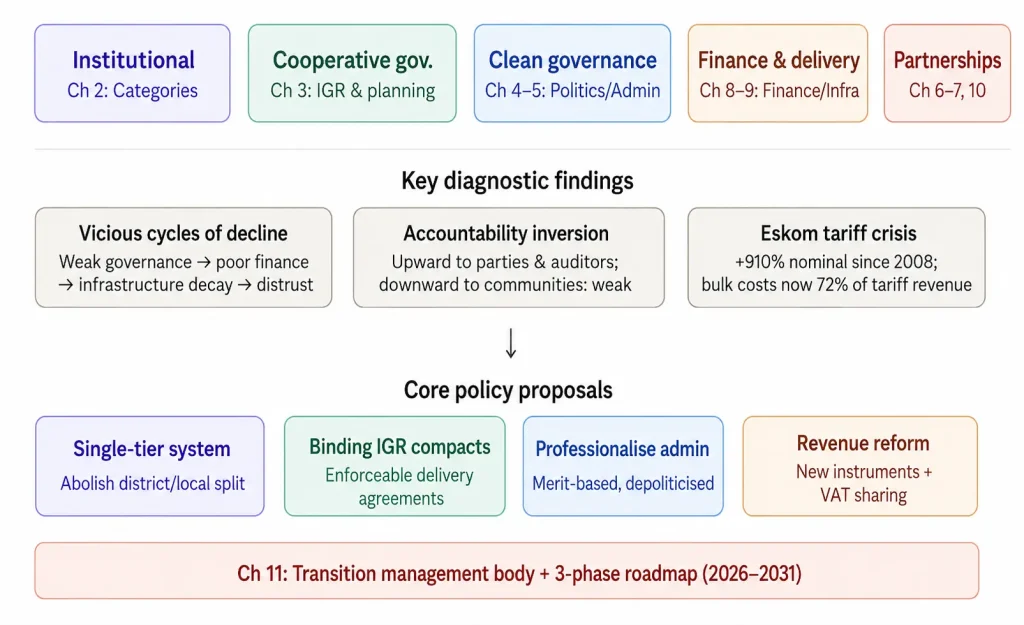
Chapter-by-chapter summary
Chapter 1 – Context and vision frames the rationale: South Africa has built the form of developmental local government but not the substance. It introduces a “relational governance triangle” of elected leadership, administration, and communities — all three currently misaligned. The revised vision: ethical, democratic, financially sustainable, citizen-centred and climate-resilient municipalities.
Chapter 2 – Institutional structure proposes replacing the existing Category A/B/C framework with a single-tier differentiated system over the long term. The “preferred end state” abolishes the district/local split outside metros through constitutional amendment. A transitional option (no constitutional change needed) would reorient districts as support bodies composed of local municipality representatives only, and widen the Category A definition to include major urban areas.
Chapter 3 – Cooperative governance and IGR proposes a national local government policy coordination centre (a regulatory clearing house), a binding powers-and-functions map, a single inter-sphere calendar, standardised intergovernmental delivery agreements, a data-driven early warning and intervention system, and a differentiated support framework. The chapter explicitly calls for the IGR shift from voluntary coordination to rules-based, enforceable cooperation.
Chapter 4 – Political system, ethics and accountability addresses the “invisible hand” of party interference, coalition instability, procurement manipulation, and impunity. Proposals include a strengthened councillor Code of Conduct with automatic escalation, minimum competencies for key office-bearers, a single national councillor induction and development system, public performance contracts for mayors, lifestyle audits, and an integrity-by-design anti-corruption package.
Chapter 5 – Administrative system focuses on depoliticising appointments: independent panels, ranked shortlists, longer fixed-term contracts (7–10 years) for municipal managers insulated from electoral cycles, a potential statutory municipal professional management association, and building a municipal digital backbone treated as a governance (not ICT) requirement.
Chapter 6 – Citizen and community relations proposes shifting from tick-box participation to collaborative partnering, strengthening ward-based structures with clear routes into the IDP/budget process, transparency-by-default dashboards, institutionalised citizen care, and digitally enabled accountability tools.
Chapter 7 – Traditional and Khoi-San leadership proposes binding municipality–traditional council compacts annexed to IDPs, funded through conditional infrastructure grants, with enforceable spatial planning procedures, structured ward-level collaboration, and a dispute resolution role for Provincial Houses.
Chapter 8 – Municipal finance provides the most detailed problem diagnosis: bulk electricity costs are 72% of tariff revenue (up from 47.6% in 2003/4); property rates have risen 134% in real terms since 2003/4; R400 billion is owed to municipalities. Proposals include differentiated revenue regulation, research into an origin-based VAT revenue-sharing mechanism, ring-fencing of trading services, reform of indigent targeting methodology, and simplified financial regulation with earlier interventions.
Chapter 9 – Service delivery and infrastructure highlights that 60% of capital budgets now need to go to asset renewal (up from 41% in 2010). Proposals include flexible service delivery mechanisms (streamlined section 78 processes, regional shared services), independent economic regulation of water and solid waste, performance-based grants, and climate-resilient infrastructure management.
Chapter 10 – Spatial transformation, economic growth and climate resilience proposes the DDM “One Plan” as a binding spatial transformation compact, a one-window approvals system, below-market disposal of strategically located public land, and treating local economic contribution as an operating-system metric (service reliability, approval turnaround times) rather than a project function.
Chapter 11 – Implementation proposes a time-bound local government transition management body (initial 2-year mandate, renewable) with 6 cross-cutting workstreams and a three-phase roadmap: stabilisation (2026–27), consolidation (2027–31), and legislative lock-in (2031).
Issues of Concern
1. Constitutional amendments required but underspecified. The preferred single-tier model requires at least two constitutional amendments — one to permit single-tier municipalities nationally, another to allow shifts of Schedule 4B/5B functions to national/provincial government. The White Paper acknowledges this but leaves the political pathway, timeline, and sequencing with ordinary legislation entirely unresolved. Given the political complexity of constitutional change, this ambiguity could indefinitely defer the preferred end state.
2. Eskom cost crisis treated as exogenous. The diagnosis of Eskom tariff increases (+910% nominal since 2008) as the primary driver of fiscal stress is compelling and well-evidenced. Yet the policy response is largely to manage the consequences at the municipal level (ring-fencing, tariff reform, indigent targeting). There is no binding mechanism to constrain bulk tariff increases or address Eskom’s pricing behaviour going forward. This gap risks the entire financial reform framework being overtaken by continued input cost escalation.
3. Implementation failure risk is self-acknowledged but unresolved. The White Paper is explicit that South Africa’s pattern is one of implementation failure rather than policy failure. However, the proposed remedy — a transition management body with no statutory authority and a suggested maximum of 8–10 members — may be structurally insufficient to coordinate 65 reforms across three spheres and multiple electoral cycles. Its relationship to existing CoGTA, National Treasury, DPME and SALGA mandates needs much clearer legal definition.
4. Differentiation risks creating second-tier citizens. The proposal that municipalities with “reduced mandates” cede functions to national or provincial government raises profound equity concerns. If national or provincial government assumes responsibility for water or electricity in failing municipalities, the accountability chain to communities in those areas becomes even more diffuse. The White Paper does not sufficiently address how communities in downgraded municipalities can exercise democratic accountability over non-municipal service providers.
5. Funding gaps for traditional council participation. Chapter 7 identifies clearly that traditional councils lack basic administrative capacity, office infrastructure and operating funds. The proposed remedy — conditional grant funding through infrastructure grants such as MIG and WSIG — is indirect and insufficient. A direct, dedicated and sustainable funding regime for traditional councils as statutory participants in local governance is proposed in principle but not costed or legislatively grounded.
6. Revenue reform proposals lack specificity. The proposal to investigate an origin-based VAT revenue-sharing mechanism is politically and technically ambitious, but the White Paper explicitly states it “cannot mandate specific own revenue instruments” and calls for further research. Given the urgency of the fiscal crisis, this deferral is a concern. The fiscal proposals overall depend heavily on economic growth materialising to unlock redistributive space — an assumption that may not hold.
7. Workforce and salary bargaining reform is underspecified. Real average municipal employee costs have risen from R259,714 per annum in 2005/6 to R431,284 in 2022/23. The White Paper identifies this as a priority but calls only for “in-depth research” and an “examination of the salary bargaining process” — without proposing reform of the SALGBC (South African Local Government Bargaining Council) process. This is a significant omission given that overstaffing and above-inflation wage settlements are structural contributors to fiscal distress.
8. Digital transformation is aspirational without resourcing framework. The digital backbone proposals in Chapter 5 are conceptually sound but depend on resolving the institutional location of a centralised local government data platform, bridging the digital divide, and building in-house municipal digital capability — all simultaneously. No costed implementation model or dedicated funding source is identified. The risk of vendor capture and failed ICT projects (which the White Paper itself acknowledges as a recurring pattern) is not adequately addressed.
9. Section 139 intervention reform may require constitutional change. The White Paper proposes earlier, more predictable intervention mechanisms but acknowledges uncertainty about whether this requires constitutional clarification. The current constitutional understanding constrains interventions to being “corrective and temporary.” This legal ambiguity should be resolved before the reform is rolled out.
10. Transition roadmap’s dependency on 2026 Cabinet adoption and 2027 elections. The roadmap is sequenced around the next municipal election term commencing in early 2027. With the comment period closing 28 May 2026, the finalisation, Cabinet adoption, and legislative drafting timeline is extremely compressed. Delays in adoption cascade into the entire phased roadmap.
Submission deadline
28 May 2026 Email: WPLG26@cogta.gov.za | RichardP@cogta.gov.za | MaphutiL@cogta.gov.za Post/hand delivery: Mr Thabiso Richard Plank, 87 Hamilton Street, Arcadia, Pretoria, 0001